
The dynasty which ruled about 50 years, was subsequently succeeded by another related Kurdish dynasty, the Hasanwayhids.
Aishanid or Aishiya dynasty
Aishani or Aisani was a Kurdish dynasty that ruled 912-961 A.D. (300-350 A.H.) over western Jibal, such as Dinawar, Hamadan, Samghan etc. in what is today known as Iranian Kurdistan as well as parts of Iraqi Kurdistan. Among the best known kings of the dynasty are Wandad, Ghanim and Daisam.

Shameran
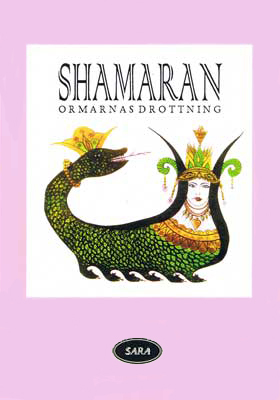
It's name literally means ''king of the snakes''. Shameran is thought to have an anthropomorphic figure with a female head on a snake body, the way she is often depicted and her pictures are traditionally hung on bedroom walls of Kurdish girls.
Shameran which can be compared with the Greek ''Mermeid'', exactly corresponds with the snake-legged goddess of earth, Api (see here), in the Scythian (ancient Kurds) mythology.
Other spellings of the name include: Shamaran, Shahmeran, Shahmaran and alike.
The Hurro-Urartian Substratum in Kurdish (1)
The toponyms are generally conservative and give insight to the human history of the region when it comes to possible linguistic influnce or shifts.
It has long been shown by scholars that significant portion of Kurdish toponymy originates from Hurro-Urartian; examples are ''Barzani'' which was name of a Hurrian god; or Kurdish clan names ''Zibari'' from ''Sippar'', ''Musuri'' from ''Musri'', or name of ''Ziwiya'' from ''Zibiya'' ( capital of Hurro-Urartian kingdom of Manna, south of lake Urmia), name vally of ''Harir'' from ''Kiruri'', and dozens other place names and hydronyms such as Xabur, Van, etc. To these also must be added the name of 'Kurdistan' itself in Kurdish (endonym), i.e. ''Kurdawari'','' awari'' being the Hurrian word meaning ''land, field''.Name of the Kurdish village ''Roboski'' is a remnamt of the name ''Eribuski'', the golden eagle of Teshup.
But so far there has been no effort to look into Kurdish vocabulary to analysis thousands of words with no etymology relating them to Iranic (IE), Arabic (Semitic) or Turkic (Altaic), but with clear Hurro-Urartian cognates.
(See also Urartian morphology and Kurdish)
(See also Urartian morphology and Kurdish)
Kingdom of Garmakan

The region around Kirkuk which is nowadays known in Kurdish as ''Garmiyan'' was in pre-Islamic era ruled by a local kingdom named ''Garmakan'' and was centered at the city of Kirkuk. This ancient kingdom could be traced back to the first and second millenia BC; according to the American scholar and iranologist Richard Nelson Frye possibly to the early Gutians who also built the city of Kikrkuk and put it as the capital of their powerful kingdom which encompassed much of modern Kurdistan. Although this is only part of the history of Kirkuk but it clearly proves the Kurdistaniness reality of Kirkuk in pre-Islamic era, as it has been in post Islamic period.
Sadaqiyan dynasty
One of the earliest independant dynasties after Islamic conquest was Sadaqiyans who ruled central and northeastern Kurdistan and were centered at Urmia.
The dynasty was founded by Sidqa ibn Ali who launched uprisings against Abbasid Caliph Abu Jafar Al-Mansur (712-775 AD).
With the help of his brothers, Sadaqa was able to liberate large parts of Atropatene as well as Mosul. Following liberating Urmia, he extended his dominion to include regions of Khoy, Salmas, Shno (Oshnavieh), Lajan, Sindus, Mukriyan etc.
During reign of Abbasid Harun al Rashid, Sadaqiyans were able to extend further their dominon, and even the governor of region of Tabriz accepted their suzerainty.
The successful expeditions by Sadaqiyans horrified Abbasids, who subsequently sent to Atropatene a large army under Khazima, who could only occupy Maragha and soon was defeated by Sadaqiyan forces. this indicates military superiority of Sidqiyans.
After Sadaqa, his son Ali took power, who even extended further his dominion. Thereafter Ali's son Sadaqa II, known as Zariq (also: Zardiq, Zarir, Zorayq, Zurayq or Zuraiq) who ruled 209-212 A.H. Like his grandfather (Sadaqa), Zuraiq was a capable warlord. He contacted with Abbasids and claimed he is ready to battle Babak Khurramdin in return for his rule over Azarbaijan and Armenia being recognized by Abbasids. The Abbasid Caliph Mamun accepted the deal and persuaded him to counter Babak Khorramdin who along with his Kurdish generals such as Ismah and Nasr was hiding in the mountains of Azarbaijan. However there is no record of confrontation of Zuraiq with Babak, which indicates a possible collusion between the two.
In 211 A.H. Zariq sent an army to Mosul in order to recapture it. He was innitially defeated however, again attacked with a force of 40.000 troops, captured Mosul and killed Sayid ibn Yonus Azdi. This angered Mamun; he sent an army under Muhamad ibn Humaid, who defeated Zuraiq; he was executed in 212 after Hijra (827-8 AD).
Ziryab, the great Kurdish polymath

Ziryab, (also spelled as Ziriab or Ziriyab) (789-857) was a polymath: a poet, musician, singer,cosmetologist, fashion designer, celebrity, trendsetter, strategist, astronomer, botanist and geographer at the Umayyad court of Córdobain Islamic Spain. He first achieved notoriety at the Abbasid court in Baghdad, as a performer and student of the great musician and composer, Ishaq al-Mawsili. Ziryab was a gifted pupil of Ishaq al-Mawsili. He had to leave Baghdad when his skills as a musician surpassed those of his teacher. He moved to Córdoba in southern Spain and was accepted as court musician in the court of Abd al-Rahman II of the Umayyad Dynasty.
Ziryab left Baghdad some time after the death of the Caliph al-Amîn in 813 and traveled first to Sham (Syria), then to Ifriqiyya (Tunisia), where he lived at the Aghlabid court of Ziyadat Allah (ruled 816-837). Ziryab fell out with Ziyadat Allah but was invited to Al-Andalus by the Umayyad prince, al-Hakam I. He found on arrival in 822 that the prince had died, but the prince's son, Abd ar-Rahman II, renewed his father's invitation. Ziryab settled in Córdoba, where he soon became even more celebrated as the court's aficionado of food, fashion, singing and music. He introduced standards of excellence in all these fields as well as setting new norms for elegant and noble manners. He was an intimate companion of the prince and established a school of music that trained singers and musicians which influenced musical performance for at least two generations after him. In the 9th Century he introduced the New Year celebration based on the Iranian holiday Newroz to the courts ofAndalusia in Spain and thence to Europe.
Ziryab is said to have improved the 'ud by adding a fifth pair of strings, and using an eagle's beak or quill instead of a wooden pick. He is said to have created a unique and influential style of musical performance, and written songs that were performed in Spain for generations. He was a great influence on Spanish music, and is considered the founder of the Andalusian music traditions of North Africa and the Middle East. Zyriab is thought to have codified the disparate elements of Arab poetic traditions of qasidah, mwashah and zajal. Abd al-Rahman II was a great patron of the arts and Zyriab was given a great deal of freedom. He established one of the first schools of music. He was a great virtuoso on the 'ud and an amazing singer. Ziryab also introduced musical instruments—notably the Persian lute that became the Spanish guitar—as well as passionate songs, tunes and dances of Persia and Mesopotamia that later, mixed with Gypsy influence, evolved into the famed Spanish flamenco. Ziryab established a music conservatory at the court of Abdel-Rahman at Cordoba. (The German scholarly book "Moorish Architecture" by Barrucand states that Ziryab also introduced good taste, fine court manners and even new hair cuts into Spain).
Ziryab is said to have had a lasting influence on fashion, bringing styles from the Middle East to Al-Andaluz, including sophisticated styles of clothing based on seasonal and daily timings. In winter, for example, costumes were made essentially from warm cotton or wool items usually in dark colours and summer garments were made of cool and light costumes involving materials such as cotton, silk and flax in light and bright colours. Brilliant colours for these clothes were produced in tanneries and dye works which the Muslim world perfected its production, for example, in 12th century Fes, Morocco, there were more than 86 tanneries and 116 dye works.[19]In daily timing Ziryab suggested different clothing for mornings, afternoons and evenings. Henry Terrace, a French historian, commented on the fashion work of Ziryab; "He introduced winter and summer dresses, setting exactly the dates when each fashion was to be worn. He also added dresses of half season for intervals between seasons. Through him, the luxurious dress of the Orient was introduced in Spain. Under his influence a fashion industry was set up, producing coloured striped fabric and coats of transparent fabric, which is still found in Morocco today.", though Terrace goes on to caution "Without a doubt, a lone man could not achieve this transformation. It is rather a development which shook the Muslim world in general, although historic legend attributes all these changes to Ziryab and his promoter, Abd-Al-Rahman II" Ziryab is known to have invented an early toothpaste, which he popularized throughout Islamic Spain. The exact ingredients of this toothpaste are not currently known, but it was reported to have been both "functional and pleasant to taste." He also introduced under-arm deodorants and "new short hairstyles leaving the neck, ears and eyebrows free," as well as shaving for men.For women, he opened a beauty parlour or “cosmetology school” near Alcázar, where he introduced a "shorter, shaped cut, with a fringe on the forehead and the ears uncovered." He also taught "the shaping of eyebrows and the use of depilatories for removing body hair", and he introduced new perfumes and cosmetics.
He also "revolutionized the local cuisine," by introducing new fruit and vegetables such as asparagus, and by introducing the three-course meal, insisting that meals should be served in three separate courses consisting of soup, the main course, and dessert. He also introduced the use ofcrystal as a container for drinks, which was more effective than metal goblets. He was an arbiter of fashion and taste. Ziryab's influence is felt to this day, especially in music and food. Prior to his arrival in al-Andalus in 822, there had been no style in food presentation since the Roman Empire. Food was served plainly on platters on bare tables, much as remains the "traditional" style in the middle east to this day. Ziryab changed that. He brought with him many dishes from Baghdad, introduced fine tablecloths and glassware instead of metal goblets, and developed a new order of service for the table. This "more elegant, better-bred and modern style" became established in al-Andalus, thence spread across the Pyrenees to Europe, and became the standard service we still use today. Hence the banquet will be served according to the precepts of Ziryab, and so will differ from the "traditional" style of serving one associates with Islamic food.
Subscribe to:
Posts (Atom)
